Overview | Pelagic Trawl Gear Impacts | Essential Fish Habitat
Assessing effects of fishing on benthic habitat in Alaska
The Fishing Effects model (FE model) is a peer-reviewed decision support tool used to assess the effects of fishing on benthic habitat in Alaska. The term decision support tool reflects that the FE model synthesizes information from literature and available data to help the Council consider tradeoffs and develop recommendations. The FE model was first developed to support the Council’s evaluation of adverse effects from fishing on essential fish habitat (EFH). It can also be used to address other fishery science and management questions.
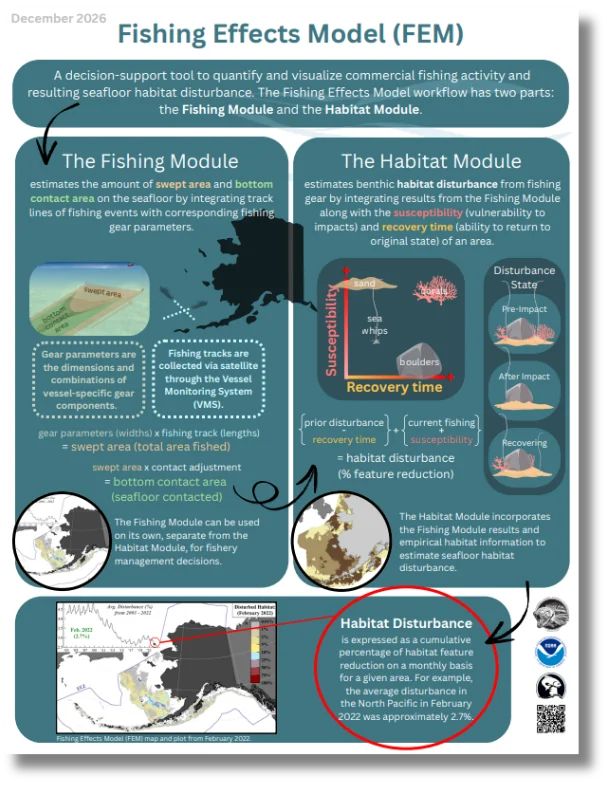
The FE model is a workflow or a sequence of steps, with two main components. This infographic provides a visual summary.
- The Fishing Module estimates the “footprint,” or amount of swept area and bottom contact area on the seafloor from fishing. It combines information about where and when fishing activity occurs, based on data from observers and Vessel Monitoring Systems, with information about the amount of bottom contact associated with different types of fishing gear. The Fishing Module can be used on its own, separately from the Habitat Module, for fishery management decisions. For example, it was used in the Council’s 2024 analysis of Groundfish Area Closures within the Bristol Bay Red King Crab Stock Assessment Area.
- The Habitat Module estimates the amount of benthic habitat disturbance caused by fishing gear. This step combines results from the Fishing Module with information about the susceptibility and recovery time of different benthic habitat types, such as mud, sand, and boulders, and the features such as sponges and corals associated with them. The FE model characterizes cumulative impacts across fishing gear types, while also accounting for the fact that once disturbed, habitats recover at different rates.
The FE model is led by researchers at the Fisheries, Aquatic Science, & Technology (FAST) Lab at Alaska Pacific University, in collaboration with the Council, NMFS Alaska Regional Office, and other academic and industry partners. The model benefits from review within and beyond the North Pacific region, and a Fishing Effects Northeast model based on the North Pacific FE model was adapted for use by the New England and Mid-Atlantic Fishery Management Councils.
The FE model was first developed to support the Council’s 2017 EFH 5-year Review. It is reviewed by the Council’s Scientific and Statistical Committee (SSC) as part of every EFH 5-year review cycle, and is updated to incorporate new data and peer-reviewed research. One example of new information is the ongoing Gear Innovation Initiative led by FAST lab researchers at Alaska Pacific University, in collaboration with industry organizations, that will be used to update the model inputs to more accurately reflect how fishing gear is configured and fished. This information will be integrated into the 2028 EFH 5-year Review and beyond.
Evaluating Pelagic Trawl Gear Impacts to Address Unobserved Mortality
The FE model is helping to inform the Council’s consideration of next steps to understand and account for unobserved mortality of prohibited species, particularly crab, and to limit bottom contact by pelagic trawl gear used in the pollock fishery. The Council is considering both regulatory and non-regulatory strategies as well as encouraging industry innovation, research, and information sharing. A June 2025 Pelagic Trawl Gear Innovation Discussion Paper described potential options.
The Council intends to consider gear research and updated bottom contact estimates from the FE model to evaluate management measures to further minimize the impacts of pelagic trawl gear in areas that are currently closed to nonpelagic trawl gear and to address potential unobserved crab mortality. (June 2025 motion). The Council recently reaffirmed this approach, stating that the FE model is the peer reviewed, best available tool to assess the effects of fishing on benthic habitats in Alaska, and clarifying that it is a habitat-effects tool and does not by itself estimate unobserved crab mortality from fishing (June 2026 motion).
Evaluating Adverse Effects from Fishing on Essential Fish Habitat
The Magnuson-Stevens Act requires Councils to describe and identify EFH in Fishery Management Plans, and minimize adverse effects from fishing on EFH to the extent practicable if there is evidence that a fishing activity adversely affects EFH in a manner that is more than minimal and not temporary in nature. EFH is defined as “those waters and substrate necessary to fish for spawning, breeding, feeding, or growth to maturity.” The FE model helps characterize the impacts of fishing effects on EFH, and informs the Council’s consideration of whether additional management actions are needed to mitigate the impacts of fishing gear on benthic habitat.
The process of evaluating fishing effects on EFH relies on the expertise of NMFS Alaska Fisheries Science Center stock assessment scientists, who examine the overlay of outputs from the Habitat Module with core EFH areas for each species to look for correlations between habitat disturbance and stock response, and identify any concerns. The methods for evaluating adverse impacts as part of the most recent EFH 5-year review are described in more detail in a NOAA Technical Memorandum: 2022 Evaluation of Fishing Effects on EFH.
The most recent EFH 5-year review completed in 2023 concluded that the adverse effects of fishing activity on EFH are no more than minimal or temporary. Resources from the 2023 review cycle are available here. The 2028 EFH 5-year Review work plan was presented to the Council in December 2025 and to the SSC in February 2026. The SSC will next receive a progress update on the 2028 EFH 5-year Review in February 2027, focusing on updates to FE model inputs. Planned data input updates include fishing effort, gear parameters (from the Gear Innovation Initiative), and habitat categorization and recovery rates.
Recent presentations to the Council and SSC
- June 2026: Harris, B.P. Gear Innovation Initiative and Fishing Effects Model Presentation | Video starts at 5:46:28)
- February 2026: Pirtle, J.P. and A. Kroska. 2028 Essential Fish Habitat (EFH) 5-Year Review Plan Presentation | Video (starts at 7:25:50)
- June 2025: Harris, B.P. C3a Gear Innovation Initiative Presentation | Video (starts at 6:59:58)
- February 2024: Harris, B.P. and C. Rose. B1 Fishing Research and Effects Modeling Presentation | Video (starts at 32:35)
Presentations to the Joint Protocol Committee (October 2026)
The Joint Protocol Committee convened at the request of the Board of Fisheries, in order to provide for information exchange and education about the impacts of bottom contact from trawl fisheries, the Council’s current management requirements, and measures under consideration. Additional resources are available on the meeting eAgenda.
- Pirtle, J. Statutory requirements for assessing the impacts of Council-managed groundfish fisheries on habitat, and tools the Council uses. Presentation (see Part 3: Habitat) | Video (starts at 1:09:12)
- Harris, B.P. EFH Component 2: Fishing Effects Evaluation. Presentation | Video (starts at 1:58:10)
- Harris, B.P. State of the Technology: Fishing Gear Research. Presentation | Video (starts at 3:18:55)
Publications and resources
Smeltz, T.S., Harris, B.P., Olson, J.V., Sethi, S.A. 2019. A seascape-scale habitat model to support management of fishing impacts on benthic ecosystems. Canadian Journal of Fisheries and Aquatic Sciences. Dx.doi.org/10.1139/cjfas-2018-0243. (Available through the NOAA document repository at https://repository.library.noaa.gov/view/noaa/54711)
Zaleski, M., Smeltz, T.S., Gardiner, S., Pirtle, J.L., and Harrington, G.A. 2024. 2022 Evaluation of Fishing Effects on Essential Fish Habitat. U.S. Dep. Commer., NOAA Tech. Memo. NMFS-F/AKR-29, 205 p. https://doi.org/10.25923/c2gh-0w03
The Fishing Gear Effects on Marine Habitats Database is a searchable collection of literature on the impacts of fishing gear on marine habitats throughout the U.S. and territories, developed with funding provided by the Mid-Atlantic Council and NOAA’s Office of Habitat Conservation, and supported through the CCC Habitat Working Group.