



NPFMC Announcements | Observer 2027 Annual Deployment Plan | BSAI Crab Harvest Specifications | Groundfish Harvest Specifications | Charter Halibut Permits Data | IFQ/CQE Transfer Changes | Council Prioritization | Changes to Scheduling of the Staff Tasking Agenda Item | Staff Tasking / B Reports |Upcoming Meetings
New Council Members and Election of Officers
At this meeting, the Council re-elected Angel Drobnica as Chair and elected Nate Pamplin as Vice Chair.
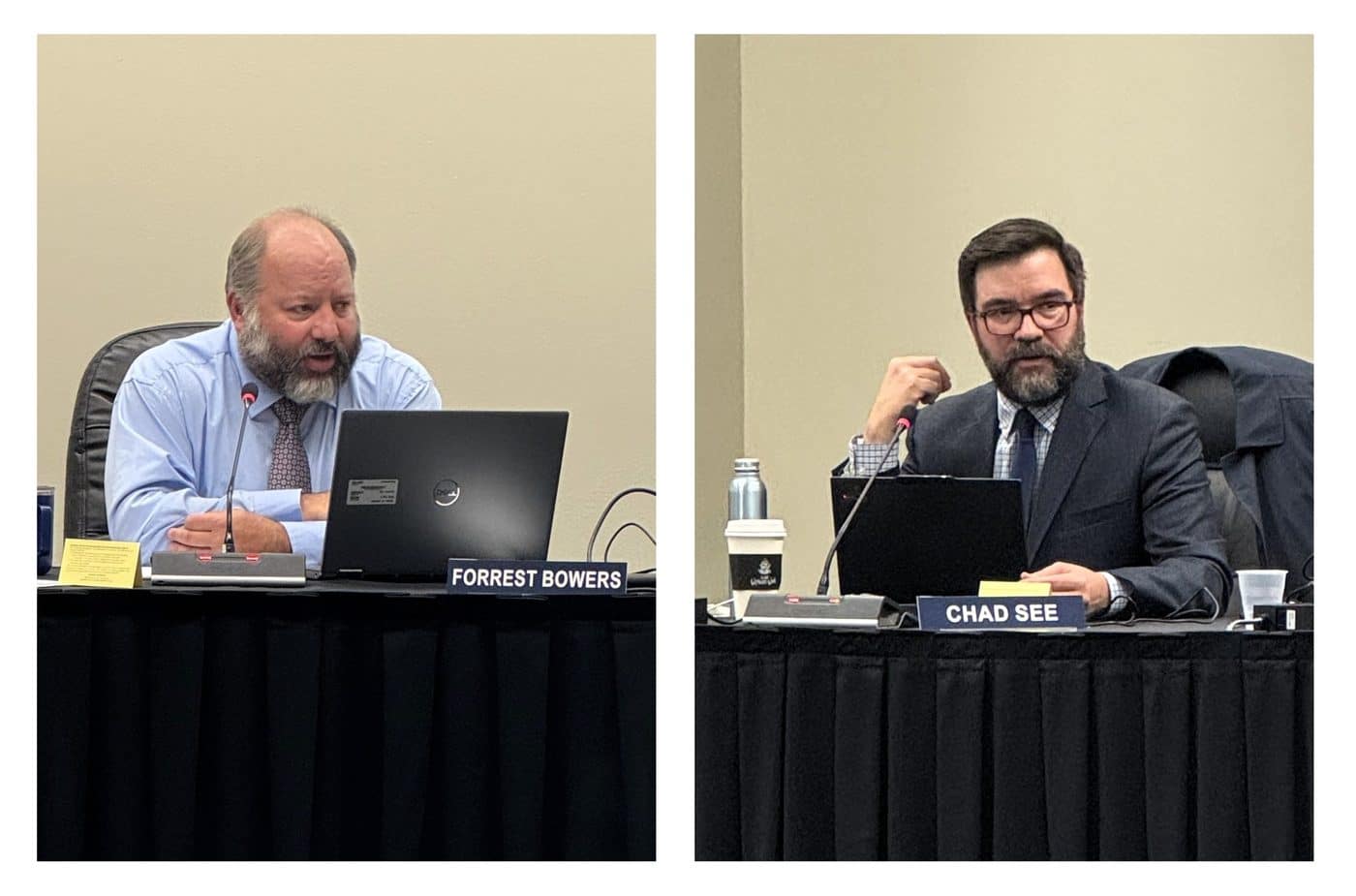
Jon Kurland, NMFS Alaska Regional Administrator, gave the oath of office to two newly appointed members: Forrest Bowers and Chad See. Mr. Bowers has served with the Alaska Department of Fish and Game (ADF&G) since 1992 and is currently Acting Director of the Division of Commercial Fisheries. Mr. See is the Executive Director of the Freezer Longline Coalition (FLC), a non-profit trade association representing Washington and Alaska-based participants in the freezer longline sector of the federal Pacific cod fisheries off Alaska. We welcome them and look forward to working with them in their upcoming terms. More information on Council members along with their bios can be found on the Council’s website.
Observer 2027 Annual Deployment Plan
The Council reviewed the Draft 2027 Annual Deployment Plan (ADP) for Observers and Electronic Monitoring in the Groundfish and Halibut Fisheries off Alaska, and provided recommendations to NMFS for the Final 2027 ADP. Observer coverage rates resulting from the selected design and the final budget are expected in the final ADP that will be published in December 2026. The Council also received a report from the recent meeting of the Partial Coverage Fishery Monitoring Advisory Committee (PCFMAC), which detailed the Committee’s recommendations and monitoring-related updates.
The Council received information from NMFS Fisheries Monitoring and Analysis (FMA) Division on the June 2026 Center for Independent Experts (CIE) review of the methods used in the draft ADP. The CIE review was a request from the SSC and Council. The CIE is an external peer-review program that provides independent scientific reviews for NOAA. The CIE review panel agreed that the methods used and associated analyses are the best scientific information and are justified for the monitoring program in the North Pacific.
The Council commended NOAA on the positive results of the review and supported further dissemination of the results to the SSC, IPHC, and other bodies.
The Council supported the NMFS recommendations on the draft ADP, including to retain the same sampling design for 2027 as that which has been deployed on the water the past several years. This design retains the same sampling unit (trip or delivery), stratification (8 partial coverage strata based on monitoring method, gear type, and FMP) and allocation method (proximity, except for trawl EM GOA).
Based on NMFS analysis, the Council also supported the following committee recommendations:
- Removing vessels from the fixed gear electronic monitoring (EM) pool in 2027 who have not complied with requirements to update and submit EM Vessel Monitoring Plans for the past 3 years.
- A yearly evaluation by NMFS to remove vessels from the fixed gear EM pool if they average less than 3 trips per year over the prior 3 years. These vessels will be placed in the at-sea observer pool and return their EM equipment to be used on active vessels.
- Vessels requesting to rejoin the fixed gear EM pool need at least 5 trips per year over the prior 3 years.
In addition, the Council requested NMFS continue to explore criteria for vessels joining the fixed gear EM pool for the first time and provide consideration for active vessels that are proposed to be removed from the fixed gear EM pool (> 0 – < 3 trips) if they can prove they do not have bunk space for an observer. The Council also noted its appreciation for the analysis of moving additional fixed gear vessels with few annual trips to the zero selection pool (i.e., no observer coverage requirements) and recognized the conclusion there were no cost efficiency or monitoring gains identified.
Staff contact is Sara Cleaver.
BSAI Crab Harvest Specifications
The Council specified overfishing limits (OFLs) and acceptable biological catch (ABC) amounts for five crab stocks, and accepted final BSAI Crab Stock Assessment and Fishery Evaluation (SAFE) report chapters. The SSC also received a presentation on information from the eastern Bering Sea (EBS) Ecosystem Status Report (ESR) relevant to recommending crab harvest specifications, and reviewed summer survey trawl results (including hybrid abundance), and several other topics from the September 2026 BSAI Crab Plan Team Report.
The Council set harvest specifications for EBS snow crab, Bristol Bay red king crab (BBRKC), EBS Tanner crab, Saint Matthew Island blue king crab (SMBKC), and Western Aleutian Island red king crab (WAIRKC). Harvest specifications for WAIRKC were rolled over from the previous stock assessment as this assessment was delayed by one year due to staff capacity issues.
Discussion during the Council meeting included the topic of increased Tanner/snow hybrid crab abundance and their management. Historically, hybrid abundance has been low and has not been an issue. However, according to the NOAA 2026 summer bottom trawl survey, large male hybrid crab abundance was unprecedented last year, and is still at a time series high, with an increase of 12% from last year, and a higher estimated relative abundance than snow crab (≥ 101 mm). Concurrently, abundance of industry-preferred male snow crab continues to be near the time series low, with a decrease of 28% from last year. Abundance of industry-preferred male Tanner crab (≥ 125 mm) is at a record high west of 166°W, and with large increases east of 166°W. This combination of results from the summer trawl survey and other factors has contributed to increased concern over potential impacts to the snow crab stock.
Although the CPT had a lengthy discussion at their May 2026 CPT meeting to cover what is known about hybrid crab, there remains great uncertainty over basic life history parameters and potential impacts to the snow crab stock. As hybrid crab are not included in a Fishery Management Plan, conservation concerns have not been evaluated, and a separate OFL and ABC cannot be set. However, there is flexibility during the TAC setting process conducted by the Alaska Department of Fish & Game (ADF&G) to include other harvest opportunities. Stakeholders indicated a desire to harvest hybrid crab without harm to the snow crab stock, and for a workshop to explore this potential and other data gaps. Stakeholders also indicated a willingness to participate in, or lead, a workshop or series of meetings on the hybrid topic. In its motion, the Council encouraged “collaboration between researchers, managers, harvesters, and processors to identify opportunities for increased Tanner/snow hybrid crab harvest without negative impacts to C. opilio or C. bairdi stocks”.
The BSAI Crab Plan Team has merged with the Council’s Scallop Plan Team, and in future will be renamed as the Crab and Scallop Plan Team.
Staff contact is Anita Kroska.
Groundfish Harvest Specifications
Under this agenda item, the Council received reports from the recent Groundfish Plan Team meetings and recommended 2027 and 2028 GOA and BSAI groundfish harvest specifications and prohibited species catch (PSC) limit apportionments for proposed rulemaking. Proposed rulemaking notifies the public of expected Council action to recommend final groundfish harvest specifications for 2027 and 2028 at the upcoming December meeting. Additionally, the Council provided direction on spatial apportionment and requested SSC input on Biologically-Informed Recommended Distributions (BRDs) for several stocks at the December meeting.
Proposed groundfish harvest specifications for both 2027 and 2028 were set to match the harvest specifications for 2027 (through March) that were previously approved and published in the Federal Register in March 2026. In December, the Council will recommend final harvest specifications based on stock assessments that incorporate the most recent survey data. When the final rule implementing those recommendations is published in early 2027, the updated specifications will replace the 2027 specifications that were approved last year. While the SSC reviewed final assessments for some stocks at this meeting, the remaining assessments for BSAI and GOA groundfish will be released in November and all assessment documents and associated Plan Team recommendations will be compiled for Council review prior to the December meeting.
The SSC reviewed the Groundfish Plan Team Reports which summarized the issues discussed and actions taken by the Plan Teams at their September meetings. The SSC received a preview of ecosystem status reports (ESRs), which provided an Alaska climate update and a preliminary assessment of ecosystem indicators for the Bering Sea, Aleutian Islands, and Gulf of Alaska, under their C2 Crab Specifications agenda item. Full presentations of these reports are expected to be provided to the Council in December.
The Council received condensed presentations of the Groundfish Plan Team reports that focused on issues most relevant to proposed specifications and some of the highlights coming out of the Plan Team meetings.
To inform the Council’s TAC recommendations in December, the Council requested the SSC provide advice on flexibility for TACs to deviate from BRDs for sablefish in the BS and AI, BSAI blackspotted and rougheye rockfish, GOA shortraker rockfish, GOA rougheye and blackspotted rockfish complex, and GOA thornyhead rockfish. The SSC already provided advice on GOA skates at this meeting that the Council will consider in December. For the final assessment of Alaska sablefish, the Plan Teams and the SSC will review spatial apportionment methods at their meetings in November and December.
Staff contacts are Sara Cleaver (GOA) and Diana Stram (BSAI).
Charter Halibut Permits Data
After reviewing a discussion paper which covered a number of Charter Halibut Permit data requests and receiving public testimony, the Council initiated an Initial Review Analysis to look at changes to the halibut Quota Share (QS) transfer restrictions for the Recreational Quota Entity (RQE) and Guided Angler Fish (GAF).
The first action alternative that was proposed is relative to the cumulative transfer restrictions between RQE and GAF. Currently in Area 2C, this cumulative limit restricts the combination of long-term RQE transfers and short-term lease transfers of GAF to 10% of the Area 2C commercial QS pool, essentially phasing out GAF if the RQE purchases up to its limit. As conditions have led to more restrictive management measures, the use of GAF in Area 2C has increased with GAF transfers currently approaching the cumulative 10% limit.
The Council stated that because of the charter business’ increased reliance on GAF leasing, there may be a need to maintain GAF access for a limited period of time. Thus, the motion requests evaluation of decoupling the cumulative limit on the transfer of IFQ to GAF and the pounds of Recreational Fishing Quota (RFQ) issued to the RQE in Area 2C. The limit on RFQ issued to the RQE would remain in place at 10% of the Area 2C QS pool. The analysis would evaluate a separate limit of 5% or 10% of the total Area 2C halibut QS pool that could be temporarily transferred (i.e., IFQ leased) as GAF. This alternative would also consider a sunset provision that would reimplement the cumulative limit as is currently in place for Area 2C (10% on the transfer of IFQ to GAF and long-term RQE transfers) 5 or 10 years after implementation.
The second action alternative would revise the annual transfer restrictions for the RQE for both Area 2C as well as Area 3A. The analysis would examine the impacts of raising the annual transfer limit in Area 2C from 1% of the commercial halibut QS pool in Area 2C to 2%. In Area 3A, the analysis would examine raising the annual transfer limit in Area 3A from 1.2% of the commercial halibut QS pool in Area 3A to 2.4%.
Staff contact is Sarah Marrinan.
IFQ/CQE Transfer Changes
At this meeting the Council initiated an Initial Review analysis to consider a suite of changes to the Pacific halibut and sablefish IFQ Program. Many of the proposed actions are related to changes in the Community Quota Entity (CQE) Program and some would be more broadly applicable for IFQ Program fisheries. The analysis will evaluate six action alternatives; one or more of these alternatives may ultimately be recommended together. The set of actions is intended to facilitate improved access to the halibut and sablefish resource, or in the case of a minimum age requirement, clarify rules for the affected public and NMFS.
The first action alternative (Alternative 2) would make changes to the Transfer Eligibilitly Certificate (TEC). The first option includes evaluating options for minimum age regulations to be established to be eligible to receive IFQ or QS by transfer. Another option would consider allowing time tendering in any U.S. commercial fishery to count toward the 150-day TEC requirement to receive annual IFQ.
The second action alternative (Alternative 3) would make changes to unloading/landing requirements for halibut and sablefish IFQ deliveries. This would include allowing IFQ to be received by a tender vessel with a registered buyer permit for delivery to a buying station or registered buyer in a port. A second option would remove the prior notice of landing requirement for small IFQ deliveries.
The third action alternative (Alternative 4) considers increasing the amount of halibut quota an individual Gulf of Alaska CQE can hold, considering a range of different limits. Under this alternative there would be no change to the limit on the total amount of quota that can be held cumulatively by all GOA CQEs. This alternative would also clarify regulations such that a CQE representing more than one community may hold up to the combined community-level cap for each individual community it represents.
The fourth action alternative (Alternative 5) would allow CQEs to assign and manage quota in-season through the use of the hired master system, authorizing one or more individuals to land CQE-held halibut or sablefish to be debited against the CQE holdings. Under this management system, the Council’s intent would continue to be that only residents of the community or communities represented by the CQE would be eligible to fish CQE-derived quota.
The final action alternative (Alternative 6) would modify requirements for the Adak CQE specifically. This alternative includes options for removing the 50,000 lb sablefish vessel use cap, removing the 50,000 lb cap on individuals leasing IFQ, and removing the residency requirement for harvesting Aleutian Islands CQE-held quota.
Staff contact is Sarah Marrinan.
Council Prioritization
The Council undertook a review of previously-initiated actions as reflected on their 3-meeting outlook and Executive Order 14276 workplan, updated the list, and identified priorities for the upcoming year. After reviewing a staff discussion paper that separated out required and routine Council actions, the Council evaluated remaining tasks with respect to their potential impact, their consistency with the Executive Order, and importantly, effort invested to date in ongoing actions as well as the capacity required to develop an analysis. The Council also considered input from the NMFS Assistant Administrator on his priorities for the North Pacific region.
Following public testimony, the Council identified top priorities for the upcoming year as the GOA tanner crab protection measures, Bering Sea herring PSC limit changes, the pelagic trawl gear performance standard paper, and adjustments to observer lead level 2 endorsement criteria. The Council weighted these particular actions for the most part because they rely primarily on the work of Council staff rather than NMFS expertise for ongoing development, acknowledging current capacity constraints at the agency. The Council reiterated its understanding that these priorities are useful to clarify how Council and agency staff should resolve any capacity bottlenecks, especially for specialized expertise. The Executive Director will, however, continue to optimize staff capacity across all Council tasking as possible, to make progress across the range of the Council’s initiated actions. As such, the Council and the public may expect to see certain actions scheduled for review sooner than the actions identified as priorities.
The Council also removed four previously-initiated but pending actions from the 3 meeting outlook and/or the Council’s EO 14276 workplan. These include streamlining the timing of charter halibut measures, allowing motion scales in the sablefish fishery, and adjusting pot gear regulations for consistency. The Council noted that removing these items is not a judgement on their merit, and reserved the opportunity to revisit their tasking if appropriate in the future. While not a Council-tasked item, the Council also removed the GOA rockfish electronic monitoring exempted fishing permit (EFP) from its EO 14276 workplan, until there is a member of the public able to develop an EFP application.
The Council discussed the letter from NMFS on regional priorities for implementing EO 14276, and particularly its four action requests for the Council. Regarding the request to consider reviewing Steller sea lion boundaries, the Council may receive more information at a future meeting to inform workload, but did not task review or evaluation of SSL areas. The action to eliminate the 2% IFQ deduction for bled sablefish has already been initiated, although not yet scheduled for Council review. In response to the request to systematically assess current FMP species with a view to removing them to the Ecosystem Component or entirely from the FMP, staff have completed much of this work already, and will complete a report to formalize a Council response. Finally, the Council is ready to collaborate with NMFS on expanded use of EFPs, and supports agency regulatory efforts to align the North Pacific application procedures with national guidance. The Council will continue to make time on the agenda to consult on EFP applications.
As an element of the prioritization discussion, the Council affirmed the NMFS Regional Office’s implementation priorities for the next year, which are listed on page 3 of the NMFS management report on the eAgenda under B2. The Council also adopted a pilot approach to initiate new tasking at two of the four Council meetings in the upcoming year, described in a separate newsletter article below. The Council intends to make this prioritization discussion an annual agenda item, to identify key priorities for the upcoming year.
Staff contact is Diana Evans.
Changes to Scheduling of the Staff Tasking Agenda Item
Due to increasing workloads and reduced resources, the Council decided to pilot an approach that limits consideration of new actions to two of its four yearly meetings, with exceptions for emergencies.
During its discussion, the Council emphasized the importance of advancing existing priorities while maintaining meaningful opportunities for public engagement and consideration of new actions. In a typical Council meeting, the public has approximately 7-10 opportunities to comment during the course of the meeting agenda. Under the proposed approach, the opportunity to raise new items not on the agenda will shift from the end of the meeting to the beginning. To accommodate this change, the Council will add time to its B reports for public comment on new items, preserving opportunities for public input earlier in the process. The traditional staff tasking agenda item where new actions may be initiated will be reserved for two meetings per year; during the other two meetings, the end of the meeting will include a brief wrap up and discussion of scheduling.
In recent years and with the adoption of remote testimony, the Council has experienced increased public engagement and has taken up a growing number of complex issues, placing greater demands on its limited capacity. To manage this workload while continuing to provide meaningful opportunities for public input, the Council will simply seek to limit Council initiation of new issues to half of its meetings in order to facilitate progress on existing prioritized items, such as those identified in the separate Council Prioritization article. These adjustments are intended to allow the Council and staff to deliberately plan and balance workload while maintaining robust public engagement.
This one-year trial will allow the Council to assess the effectiveness of these changes and identify any unintended consequences. The approach is consistent with practices used by most other regional councils.
Staff contact is Diana Evans.
Staff Tasking / B Reports
The Council reviewed agency reports and staff tasking materials and had a substantial discussion on prioritization (see above newsletter article on Council Prioritization). The revised 3 meeting outlook reflects this guidance.
The following highlights additional Council discussions or actions.
Advisory groups
- Appointed Mr. Andrew Olson, a member of NMFS Inseason Management Branch, and Dr. Andrew Whetten, a Biometrician in the Commercial Fisheries Division at ADF&G to the Bering Sea and Aleutian Islands Groundfish Plan Team.
- Appointed Mr. Aaron Lambert, a Biometrician in the Commercial Fisheries Division at ADF&G to the Gulf of Alaska Groundfish Plan Team.
- Appointed Dr. Lee Cronin-Fine, a Research Fishery Biologist at NMFS’ Alaska Fisheries Science Center to the Crab and Scallop Plan Team.
- Approved revised Terms of Reference for the Legislative Committee and the Executive/Finance Committee.
Letters / Recommendations
- The Council recommended that the NMFS Alaska Fisheries Science Center develop a new social and economic snapshot report to show the social and economic ramifications of Alaska’s losses or changes in federal marine survey capacity in recent years. The intent for this report is to quantitatively estimate the loss in economic value (via foregone harvest) from fewer surveys and surveys with reduced scope for several primary species in the BSAI and Gulf of Alaska.
- The Council supports NMFS approval of an EFP application from SeaShare, Inc & Glacier Fish Co. The applicants propose to test an alternative processing workflow on a single trawl catcher/processor to allow a limited amount of Pacific halibut that remain in the catch, after halibut deck sorting and after sampling by a fisheries observer, to be retained and donated through the Prohibited Species Donation Program, instead of being discarded at sea as required by regulation.
- The Council requested the IPHC provide specific information as part of their annual report to the Council in February, including: total constant exploitation yields, spawning stock biomass, and total biomass estimates between 2014 and 2026; trends of historic U26 and O26 non-directed commercial discard mortality in Areas 3A and 3B; increases in unguided-recreational mortality in Areas 2C and 3A; explanation of the different IPHC and NMFS methods for calculating directed commercial discard mortalities; and any recent information on the impacts of changing the commercial size limit on both discards and harvest.
- Provide an opportunity on a future agenda, potentially the February 2027 B reports, for a joint report from USFWS, ADF&G and the Qayassiq Walrus Commission regarding available data, information and practical steps towards addressing concerns related to the potential impacts of commercial fishing and vessel activity in the Togiak Bay/Round Island area on walrus populations in the Bristol Bay Region.
Staff contact is Anna Henry.
Upcoming Meetings
- Joint Protocol Committee: October 16, 2026 (Anchorage, AK)
- Charter Halibut Management Committee: October 21, 2026 (Virtual)
- Crab and Scallop Plan Team: November 5th, 2026 (Virtual)
- Joint Groundfish Plan Teams: November 16 – 20th, 2026 (Seattle, WA)
- Charter Halibut Management Committee: December, 2026 (exact dates TBD)
- Crab Modelling Workshop: January 11-14, 2027 (TBD)