


June 12, 2025
FOR IMMEDIATE RELEASE : Contact David Witherell at 907-271-2809 or Diana Evans at 907-271-2815
Council Action on Pelagic Trawl Gear
At its June meeting, the North Pacific Fishery Management Council (Council) took two separate actions to update the definition of pelagic trawl gear to allow required salmon excluders and to incentivize gear innovation and develop spatial closures for the pollock fleet in 2026 to protect Bristol Bay red king crab, after receiving significant public testimony and several analytical presentations.
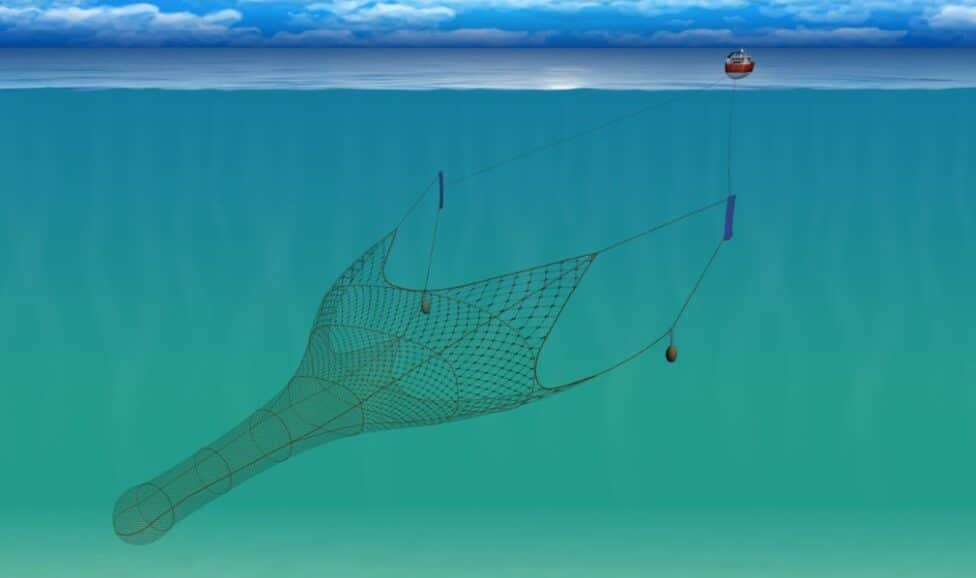
The Council’s first action was a response to outdated regulations. In 2022, the Council learned the current Federal pelagic trawl gear definition had not been updated since 1993 and did not reflect modern pelagic trawl gear configurations which have been developed in response to conservation and management objectives. The Council’s action was needed to allow the continued use and innovation of bycatch excluder devices designed to reduce salmon bycatch, allow instrumentation necessary to monitor net performance, and remove unnecessary outdated text.
The Council’s second motion is focused on pelagic trawl impacts and requested discrete pollock fishery closures to protect Bristol Bay red king crab in 2026, while emphasizing that Chinook avoidance should continue to be prioritized. Pelagic trawl fishing is allowed in some areas closed to nonpelagic trawl gear, due to the design differences in how the gear operates, and ongoing research is being done to better understand how pelagic trawl gear interacts with the sea floor. In this motion, the Council affirmed that the peer-reviewed Fishing Effects (FE) model is the best available tool to assess the effects of fishing on essential fish habitats in Alaska. Results from the most recent Essential Fish Habitat (EFH) 5-Year Review conclude habitat disturbance within the core EFH area for each species is not affecting any stock in ways that are more than minimal or temporary (as required under the Magnuson Stevens Act) and cumulative impacts were less than 5% of total EFH in the Bering Sea/Aleutian Islands and Gulf of Alaska for all gear types. However, uncertainty exists regarding unobserved mortality of crab interactions, and to date there has been limited research directed on this issue.
Of particular concern to the Council is the decline in the abundance of Bristol Bay red king crab, resulting in several years of poor recruitment and fishery closures. While ecosystem shifts are known to be a primary driver of these declines, the Council notified the public in February 2024 that it intended to use new data from ongoing research to develop discrete dynamic closures of known crab abundance during vulnerable life stages, until uncertainty about gear interactions could be resolved, and outlined objectives to guide industry research and gear modifications. The Council shared this intent after considering options for a fixed closure of the Red King Crab Savings Area to groundfish gears, which the Council deemed ineffective at meeting its crab recovery and bycatch objectives, based on best available information.
The Council’s second motion was informed by research updates provided by Alaska Pacific University’s Fisheries, Aquatic Science, & Technology Lab on the Fishing Effects Model and Gear Innovation Initiative which will improve estimates of bottom contact and cumulative habitat disturbance from model results, gear simulations, and field work. New and ongoing crab research also demonstrated potential to improve understanding of snow and red king crab distribution, energetics, and unobserved mortality in the Bering Sea.
The motion requested progress be made on the following efforts with an associated timeline requested for reporting:
● December 2025: Bering Sea pollock industry report information on development of dynamic spatial closures to protect Bristol Bay red king crab in 2026.
● April 2026: Gear Innovation Initiative, Bering Sea Fisheries Research Foundation, and Exempted Fishing Permit report updates on ongoing research
● In 2026, the Council intends to use the updated bottom contact estimates in the Fishing Effects model and gear research to develop options to revise the performance standard for pelagic trawl gear operations, based on previously stated Council objectives and available information.
For more detailed information:
1) pelagic trawl gear definition Council motion
2) pelagic trawl gear innovation Council motion
North Pacific Fishery Management Council is one of eight regional councils established by the Magnuson-Stevens Fishery Conservation and Management Act in 1976 (MSA) to manage fisheries in the 200-mile Exclusive Economic Zone, 3 miles off the coast of Alaska. Per the MSA, the 11 voting members serving on the Council are made of up people appointed by the Secretary of Commerce, and the state marine fisheries commissioners from Alaska, Washington, and Oregon as well as the Regional Director of the National Marine Fisheries Service. Federal fisheries decisions must be consistent with the Magnuson-Stevens Act and other federal laws.The Council, along with the advisory bodies, were formed so federal fishery management decisions could be made at a regional level, emphasizing public input.